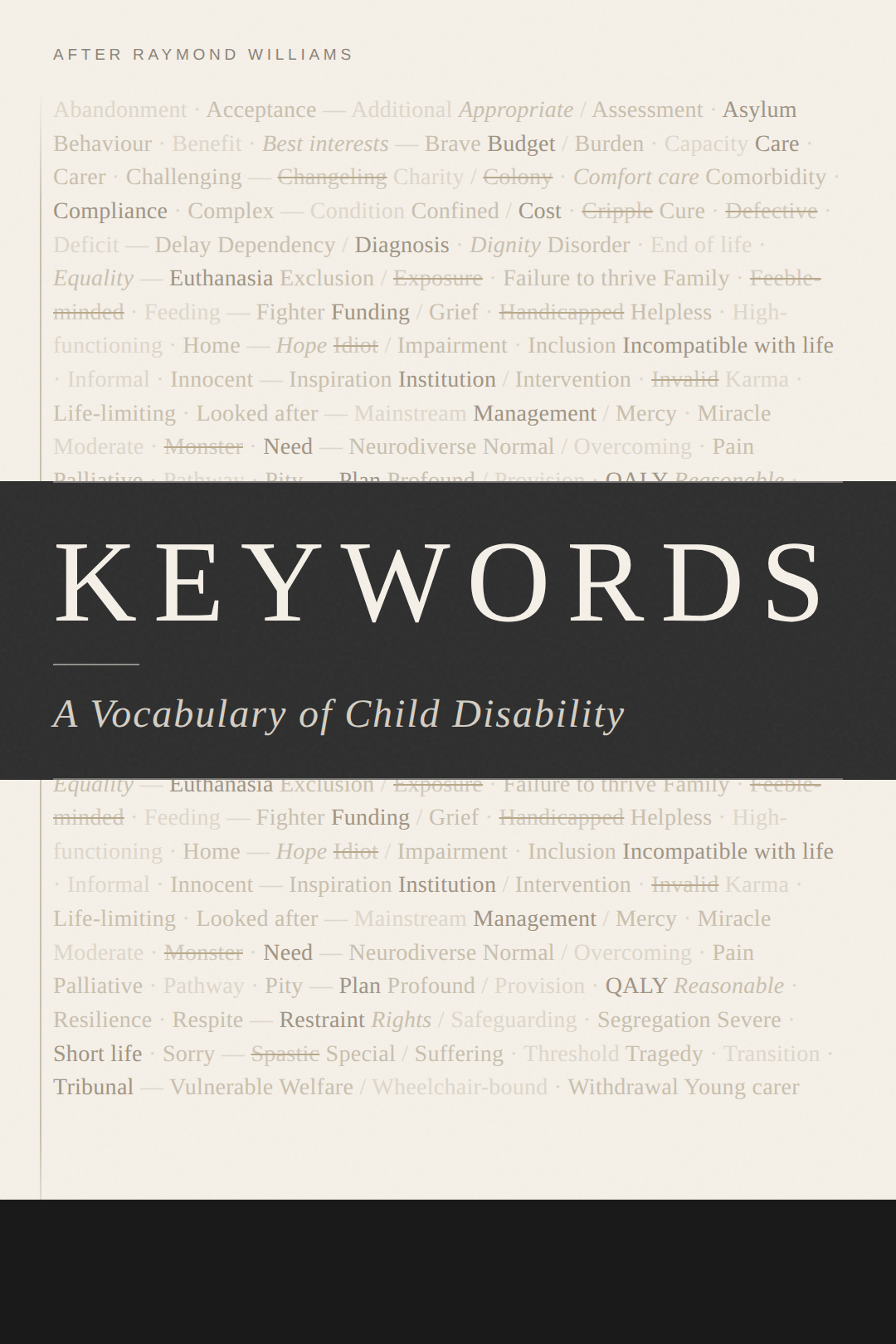
A Vocabulary of Child Disability
The words do not describe disabled children. They describe the culture’s anxiety about disabled children, and in describing it, they reinforce it.
From the Introduction

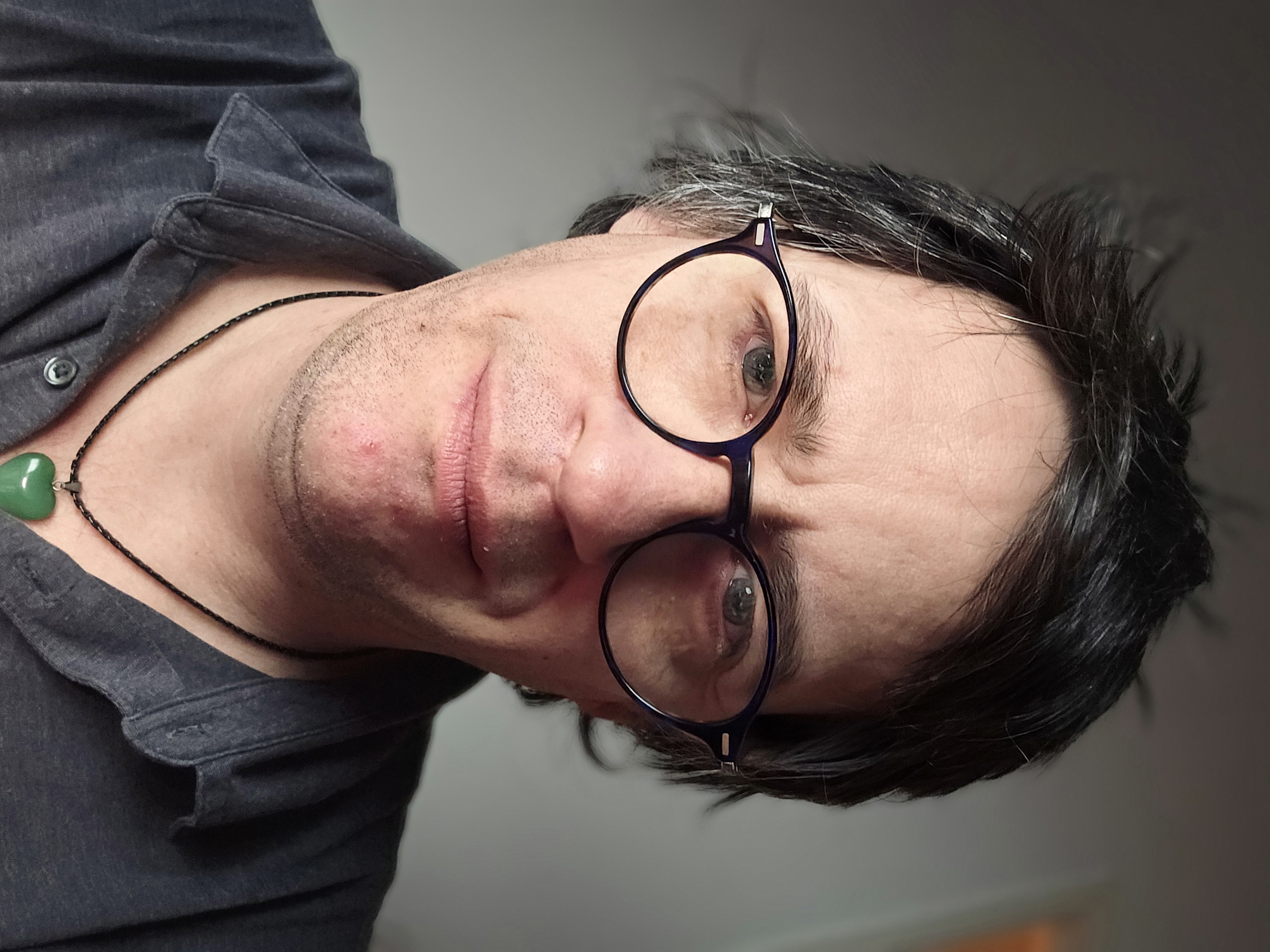
Dan McEvoy is a writer whose daughter Elisa lived with cerebral palsy, dystonia, and complex medical needs for nearly ten years. She died in January 2023.
During the decade of Elisa’s life, Dan encountered the enormous vocabulary that surrounds disabled children and their families in Britain — clinical language, policy language, sentimental language, bureaucratic language — and came to understand that none of it was neutral. Every word was doing work.
Keywords applies the method of Raymond Williams’ Keywords: A Vocabulary of Culture and Society (1976) to that vocabulary. It is analytical, not prescriptive. It does not tell readers which words to use. It shows what the words are doing once they have been used.
Dan lives in Kuopio, Finland.
The word need appears in almost every statute governing disabled children’s lives in Britain. It looks like it is about the child. It is about the budget. The word special was introduced to replace medical categories of deficit. Within a generation it had become a mechanism for segregation. The word care means tenderness, and it means warehousing, and the history of disabled children is the history of that ambiguity being exploited.
Each of the 177 entries in Keywords takes a single word or phrase from the medical, educational, legal, bureaucratic, or everyday vocabulary of child disability and traces its history, examines its current usage, and asks what ideological work it is performing. The entries are designed to stand alone. A reader can open to any page and find a complete essay. But over the course of the book a cumulative argument emerges: that this language is not a reflection of how we think about disabled children. It is a mechanism by which we avoid thinking about them.
The book draws on etymology, policy analysis, disability studies, and a decade of lived experience inside the systems it examines.
People say sorry when they learn your child is disabled. They say it in the supermarket, at the school gate, in the hospital corridor, and in the consultant’s office. They say it when they first hear the diagnosis, and they say it again years later when they are reminded. It is the most common single-word response to childhood disability in English, and it is almost never examined.
The word arrives from Old English sārig, meaning pained or distressed, which itself derives from sār, a wound. To be sorry was originally to be wounded — not to have caused a wound, but to carry one. The shift from a description of one’s own state to an expression of sympathy for another’s is gradual and begins in the medieval period, but the wound never entirely heals. Modern sorry retains the trace of the speaker’s distress even when it is offered as comfort for the listener’s. When someone says I’m sorry about a disabled child, the word reveals what it conceals: the speaker’s own discomfort, made presentable as compassion.
This is not to question the sincerity of the people who say it. Most are genuinely moved. But the word performs a function that exceeds its intention. By framing disability as something to be sorry about, it converts the child’s existence into a loss in the first seconds of every conversation. The child is alive. The child is present. And the first word the culture reaches for is the word it uses for bereavement.
See also: Acceptance · Bereavement · Brave · Grief · Pity · Tragedy
I began this project because of a word. The word was sorry. People said it to me constantly after my daughter was born, and then differently after she died.
From the Introduction
Each keyword belongs to one or more thematic clusters, showing how medical, economic, institutional, and affective vocabularies reinforce each other.
Key facts, publication details, and the story behind the book. Ready for editorial use.
Download PDF ↓Suggested questions covering methodology, personal motivation, specific entries, and the politics of language.
Download PDF ↓Complete entries available for excerpt or adaptation. Contact for access.
Request access →Advance copies in ebook and print for bona fide reviewers, academics, and media.
Request a copy →Available for guest lectures, conference presentations, podcast interviews, and panel discussions.
Get in touch →